
Conservation
Our conservation team provides high-quality, cost-effective services to retrieve, preserve, reveal, and record archaeological objects and materials.
Who We Are
Based in York, our team brings decades of experience to every project, from entire shipwrecks to a singular brooch. We combine in-house expertise with access to trusted external specialists to provide seamless conservation and specialist investigation.
Our city-centre laboratory is equipped with advanced tools for assessment, investigation, and display-standard conservation. For larger objects and waterlogged materials, our off-site facility acts as a conservation hub. It offers extensive storage and processing capabilities, including four freeze-dryers with our largest accommodating items up to 5m x 1.4m. With extensive experience in the conservation of waterlogged and fragile materials, we have treated objects on a global scale, providing tailored solutions from excavation to display.
We provide a comprehensive range of services, including:
- X-radiography
- Condition assessments for archaeological material and museum objects
- Conservation of marine archaeological artefacts
- Freeze-drying of large-scale, waterlogged organic assemblages
- Integrated woodworking analysis and stabilisation of waterlogged wood from terrestrial and marine sites
- Wood species identification
- Conservation of museum objects
- Investigative conservation of small finds, including air-abrasion
- Comprehensive object care, from immediate stabilisation to archive or display standard
- Recovery of fragile artefacts under controlled conditions
- Micro-excavation of block lifts
- Specialist packaging and custom storage solutions for archival deposition
- Collaboration with in-house and external specialists
With our reputation for expertise and access to specialist equipment rarely available elsewhere, we provide conservation solutions you can trust – whether your object is large, small or somewhere in between.
Who We Work With

An Introduction to Recording Waterlogged Wood
Join York Archaeology Conservation’s Steve Allen (BA, MA, MCIfA) for the return of his CIfA accredited one-day introductory course on waterlogged wood. This course is perfect for archaeologists who require a working knowledge of waterlogged wood, including how to identify it, record it and the valuable information it can reveal. The course is aimed at field archaeologists at all levels but it is also accessible to students who have completed some field-based training.
Conservation Case Study: Quayle Dock, Isle of Man
During the excavation of Peggy, an 18th-century yacht and one of the earliest surviving examples of its kind, a remarkable collection of artefacts was found at Bridge House in Castletown, Isle of Man. Owned by George Quayle, (1757 – 1835), a local politician and banker, the artefacts were linked to his private dock. Manx National Heritage brought them to our team for specialist conservation.
The late 18th-century collection included a range of waterlogged materials such as wood, leather, and iron. Among the most significant finds were components of the original dock gate mechanism as well as shipping elements such as tillers and moulded decoration.
The conservation treatment began with a crucial step common to all marine-recovered objects: desalination. This process removes harmful chlorides absorbed during prolonged saltwater exposure.


Organic materials were then treated through chelation to remove iron staining that could lead to future deterioration. Following this, objects were immersed in varying concentrations of polyethylene glycol (PEG), a water-soluble wax, to stabilise their structure and prevent collapse of the cell walls during drying.
To remove the water without damaging the artefacts, we used our large freeze-dryers. Through sublimation (the transformation of ice directly into water vapour), we avoided shrinkage and cracking, preserving the integrity of these fragile materials.
Once dried, the artefacts were carefully cleaned and consolidated to prepare them for long-term preservation in archival storage.
The conserved assemblage has now been returned to Manx National Heritage, where it contributes to ongoing research and interpretation of the island’s maritime history.
Due to the scale and complexity of the project, the treatment became a collaborative effort involving professional conservators alongside conservation students, past and present, offering a valuable training opportunity and ensuring the successful stabilisation of the assemblage.
Conservation Blog
Contact Us
Email: [email protected]
Staff Profiles
Steve developed an interest in waterlogged wood in the early 1980s while volunteering at Bordesley Abbey. An initial curiosity led him to pursue an MA dissertation at Birmingham University in 1988, focusing on woodworking technology.
With limited job opportunities in the field at the time, he gained broad archaeological experience through various roles, including work with the Museum of London’s Department of Urban Archaeology, Bordesley Abbey, and the Welsh Severn Estuary projects. His fieldwork spans deep urban, open rural, and intertidal archaeology.
As well as extensive experience in the recording and analysis of waterlogged wood and timber, Steve also has significant expertise in site planning and post excavation illustration. The latter work includes Iron Age copper alloy artifacts from Cadbury Castle, the Bramley Iron Age mirror, and Anglo-Saxon grave goods. His skills were particularly valuable in illustrating the Iron Age Pocklington Shield. (See key publications—second edition in preparation.)
Steve joined the Association of Archaeological Illustrators and Surveyors in 1990, later chairing its membership interview panel and ultimately serving as Chair, where he played a key role in its merger with IfA. He has held several significant positions within CIfA, including:
- Chair of the Graphic Archaeology Group
- Member of the Validation Committee (2012–2017, 2018–2024)
- Elected member of the IfA Council and Executive Committee (Vice Chair for Membership & Personnel)
- Member of the CIfA Board of Directors until 2018
- Currently serves on the CIfA Advisory Council
Outside of his conservation and illustration work, Steve is an active member of Leeds-based Commoners Choir, founded in 2015 by Boff Whalley (formerly of Chumbawamba).

Qualifications & Training
- BA (Hons) Archaeological Studies University of Leicester 1987
- MA Archaeological Practice University of Birmingham 1988
- Full Driving licence
- First Aid at Work certificate
Current Memberships
Member of the Chartered Institute for Archaeologists (MCIfA) 2011-
Favourite object/project to have work on so far at YA:
At YA it has to be the Hungate boat planks, slabs of non-Viking hull sections reused as part of Anglo-Scandinavian Building 1. It’s certainly the project I’ve been invited to talk and give papers about most often!
Key Publications:
- Allen, SJ (2023) ‘House and Boat: Reuse of Ship Planking in a 10th Century Building at Hungate, York’ International Journal of Wood Culture 3 (2023) 1–9
- Allen, SJ (2017) ‘Wooden artefacts’ and ‘Structural Timbers’ in Ford, B, Brady, K and Teague, S From Bridgehead to Brewery: The Medieval and Post-Medieval Archaeological Remains from Finzel’s Reach, Bristol. Oxford Archaeology Monograph 17, Oxford
- Allen SJ, (2014) ‘The woodworking technology of the Anglo-Scandinavian timbers from 16-22 Coppergate’ in Hall RA Anglo-Scandinavian Occupation at 16-22 Coppergate: Defining a Townscape. The Archaeology of York AY 8/5, CBA, York
- Allen, SJ ,(2013) ‘Watermill machinery and fittings from the excavations’ ‘Wooden objects’ and ‘Structural Timbers’ in Ford, B, Poore, D, Shaffrey, R and Wilkinson DRP Under the Oracle. Excavations at the Oracle Shopping Centre site 1996-8: The medieval and post-medieval urban development of the Kennet floodplain, Reading Thames Valley Landscapes Monograph no. 36 , Oxford
- Allen, SJ (2010), ‘Woodworking Technology’ in Landscape evolution in the middle Thames Valley: Heathrow Terminal 5 Excavations Volume 2. Framework Archaeology.
- Allen SJ (2006), ‘Wooden finds’ in Landscape evolution in the Middle Thames Valley: Heathrow Terminal 5 Excavations Volume 1. Framework Archaeology
- Allen SJ, Goodburn, D, McComish, J, Rogers, P, Spriggs, JA (2005) ‘Re-used boat planking from a 13th Century revetment in Doncaster, South Yorkshire’ Medieval Archaeology 49, 281-304
- Allen, SJ and Bell, M (2000) ‘Reconstruction of rectangular buildings 6 and 1’ in Bell M,, Castledine A and Neumann H (2000) Prehistoric Intertidal Archaeology in the Welsh Severn Estuary CBA Research Report 120, 130-136
- Allen, SJ (1994) The Illustration of Wooden Artefacts An Introduction and Guide. AAI&S Technical paper No. 11 (second edition in preparation.)
- Allen, SJ (1993) ‘Structural Timbers’ and ‘Wooden Objects’ in Astill, GG A Medieval Industrial Complex and its landscape: The Metalworking Watermills of Bordesley Abbey CBA Research Report 92, York
Morgan Creed is a Conservator for York Archaeology, specialising in waterlogged organic artifacts and finds from marine archaeological environments. She is passionate about developing standardised treatment protocols based on quantitative analysis and promoting sustainability in conservation practices.
Morgan earned a First-Class BA (Hons) in Conservation & Restoration from the University of Lincoln, where she gained hands-on experience in decorative arts conservation, including the restoration of gilded surfaces and marine archaeological materials. She later completed an MSc in Conservation Practice at Cardiff University, focusing on the treatment of composite museum objects such as model ships and polychrome Egyptian tomb models.
During her studies, Morgan undertook placements at the Imperial War Museum (HMS Belfast) and the Mary Rose Museum, where she worked on archaeological wooden artifacts, including arrow shafts and a gun carriage wheel. She interned at the Newport Medieval Ship Project, assisting with the consolidation of large ship timbers and the assessment of mixed-material small finds.
Following her studies, Morgan worked for the National Trust and the National Museum of the Royal Navy (NMRN). At NMRN, she was responsible for the conservation and care of historic vessels, carrying out large-scale treatments such as removing modern overpainting on HMS Victory. She also undertook object conservation for major exhibitions, such as the Victory Gallery (2021) and the Nighthunters Coastal Forces Exhibition (2022).
In addition to practical conservation, Morgan implemented preventive conservation procedures, such as Integrated Pest Management (IPM) and environmental data monitoring, on HMS Victory, HMS Warrior, HMS M.33, HMS Alliance, and Holland I. Her time in the Dockyard also expanded her expertise in managing hazards in historic interiors and collections.
Morgan joined York Archaeology in August 2022. She specializes in stabilizing materials from archaeological sites across the UK and conserving composite museum objects for clients such as Yorkshire Museums Trust, Historic England, and Cambridge University. She has contributed to the conservation of shipwreck artifacts from HMS Invincible and the Swash Channel Wreck.
Morgan has been an active member of ICON since 2016 and is currently working towards her professional accreditation.

Qualifications & Training
- MSc Conservation Practice – Cardiff University (2016 – 2018)
- BA (Hons) Conservation and Restoration: First Class – University Of Lincoln (2012 – 2015)
- First on Scene: Qualsafe Level 3 Award in First Aid at Work (Nov 2023)
- Patina Art Collection Care Ltd: Art and Object Handling (Apr 2022)
- How2HR: Liberating Leadership (Jun 2021)
- PETA: Confined Space and Entry Awareness Training (Feb 2020)
- International Academic Projects: Chemistry for Conservators (Dec 2015)
- Sturge Conservation Studio: Practical Leather Conservation Course (Jun 2013)
Previous Employment
Conservator: National Museum of the Royal Navy
November 2019 – August 2022
- Practical object conservation; keeping to deadlines in short timeframes, e.g. 120 objects conserved in six weeks for the Nighthunters Coastal Forces exhibition.
- Management of Shipkeepers responsible for daily conservation cleaning of the ships.
- Industrial conservation of dynamic objects, such as the engine aboard HMS Warrior.
- Minimising risk from hazards present in historic interiors and collections, including: lead paint, mercury, asbestos and radioactive materials.
- Implementing preventive conservation procedures, such as IPM and environmental data monitoring on HMS Victory, HMS Warrior, HMS M.33, HMS Alliance and Holland I.
Freelance Conservator: Elliott Ryder Conservation
January 2019 – August 2019
- Producing condition assessments and treatment proposals for war memorials.
- Large scale conservation of war memorials, including: removal of failing mortars; cleaning disfiguring biological growths and industrial steam cleaning.
- Cleaning, consolidation and re-assembly of decorative stone sculpture.
- Safe working at heights up to 10 meters.
Conservation Internship: Newport Medieval Ship Project
July 2018 – August 2018 (Volunteer: May & September 2017)
- Assessing the condition assessments of small finds and performing remedial conservation treatment.
- Evaluation of current object storage and repackaging where necessary.
- Removal and packaging of timbers from PEG tanks, for freeze-drying.
Conservation Student Placement: Mary Rose Museum, Portsmouth
June 2017 – August 2017
- Practical conservation of organic artefacts, including large-scale consolidation of wood objects in PEG.
- Assisting with preventive conservation tasks, including integrated pest management systems and daily monitoring of RH in display cases.
- Producing analytical data for a commercial research project, via PXRF and FTIR.
- Liaising with the public; providing conservation demonstrations during National Archaeology Week.
Visitor Experience Officer: National Trust, Oxburgh Hall
July 2015 – August 2016
- Responsibility over all advertising and marketing for Oxburgh Hall: including social media, content for Adobe email systems and producing website content via Oracle and Vader systems.
- Project management of Oxburgh’s Visual Identity: a visual interpretation of the property’s spirit of place statement.
- Acting as a rotational Duty Manager: resolving operational issues including power cuts and sewage pump malfunctions.
Conservation Student Placement: Imperial War Museum, HMS Belfast
May 2014 – August 2014
- Project management over restoration of the Electrical Workshop exhibit: devising and implementing treatment strategies to return it to its 1959 appearance.
- Supervision of volunteers assisting on the project; utilising team work and team leadership to deliver final treatment outcomes.
- Speaking with visitors while carrying out conservation treatments in public.
Professional Memberships
The Institute of Conservation (ICON)
Favourite object/project to have work on so far at YA:
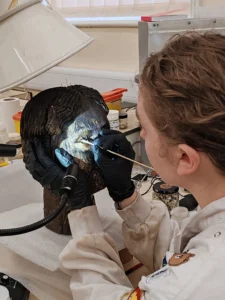
I’m currently working on a euphonium from the wreck of The Kyarra (1903). Marine archaeological material has always been my favourite to conserve, as there is a real difference before and after. Such objects are often covered in layers of concretion, rendering them barely recognisable: after conservation, you can view the object as it once was.
The euphonium is particularly exciting to work on as it was crushed and damaged during the sinking. It encapsulates the elegance of a ship in its sailing life in juxtaposition to the trauma of how it ended up on the sea bed. Removing the concretion from the bell of the euphonium uncovered the maker’s mark and the beginnings of a copperplate inscription, but I still have some cleaning to do before the object’s secrets are fully revealed.
When treatment is complete, the euphonium will be going on display at Poole Museum.
Publications:
Creed, M., Emmerson, N., Middleton, A., Pearson, D., Schofield, E., Thunberg, J. and Watkinson, D. (2022) Hanging by a Thread: The effect of PEG treatment on the tensile properties of waterlogged archaeological rope from The London. In: Proceedings of the 14th ICOM-CC Group on Wet Organic Archaeological Materials.Conference, Portsmouth, UK 20-24 May 2019.
Scarlett Crow is an Objects Conservator with a passion for metals and the discovery of unusual mineral-preserved organics. She enjoys science communication and actively showcases the lab’s research and conservation successes on social media.
Before entering the conservation sector, Scarlett explored diverse fields, including Biomedical Science and Theatre. She produced several shows at the Edinburgh Fringe before a final-year research project at a local museum—along with a gifted taxidermy workshop—inspired her to pursue conservation professionally. This led her to applying for a Master’s in Conservation at Durham University in 2020.
Scarlett joined York Archaeology as a student in 2021, demonstrating a strong aptitude for conservation and progressing to Conservator in 2024. She has worked on several high-profile projects, in Marine Archaeology Conservation which include finds from the HMS Gloucester, HMS Invincible, and the Swash Channel Wreck. More recently Scarlett has worked on objects for the Yorkshire Museum including the Star Carr headdresses and for the National Coal Mining Museum where she worked alongside her colleague Steve Allen to conserve and install a Starvationer boat for display.
Scarlett has been an active member of ICON since 2020 and regularly attends working group AGM’s and events.

Qualifications & Training
- MA Conservation of Archaeological and Museum Objects – University of Durham (2020-2022)
- BSc (Hons) Biomedical Science – University of Warwick (2016-2019)
- Accredited by the Royal Society of Biology
- First Aid at Work (Nov 2024)
- Laser Cleaning Training – Lynton Conservation (April 2022)
- ICON Student Mentorship & Membership Grant (2021)
- Plowden Scholarship (2021)
- York Foundation for Conservation and Craftsmanship Bursary (2021)
Previous Employment
Conservation Internship – Leeds Museums & Galleries (2021-2022)
Research Assistant – Herbert Art Gallery & Museum (2019)
Current Memberships
ICON Associate
Favourite object/project to have work on so far at YA:
When I was still a student one of my first objects was a Romano-British copper alloy wine strainer that came in for investigation. This initially involved x-radiography which revealed the perforated bowl to have a beautiful floral motif and the handle to have been decorated with incised concentric circles, all hidden away under layers of corrosion products. Removing the corrosion layers was extremely satisfying as the surface had a stunning patina and I could use the tip of a porcupine quill to clear out each perforation.
Publications:
- Crow, S.J. (2023). Gloucester Shipwreck 1682: Treatment of a Leather Book Cover [Poster]. Presented at: ICON Archaeology Group: Save our Skins! Archaeological Leather – Research and Conservation. London, UK. 27th June 2023.
Sophie joined York Archaeology as a Conservator in early 2022 after completing her MA in Conservation of Archaeological and Museum Objects at Durham University and volunteering as a Conservator at Durham Castle.
Since joining York Archaeology, she has played a key role in various terrestrial and maritime conservation projects, including the Gloucester project. She has also collaborated with museums and exhibition teams, contributing to projects such as Hull Minster’s Revival – Back to Life exhibition.
During her placement year, Sophie conducted a research project on the Oddy Test, developing a toolkit with guidelines and supporting documentation to aid conservation practices.
Before specialising in conservation, Sophie pursued a broad academic background in Archaeology, History of Art, Egyptology, and Archaeobotany. She earned a BA in Archaeology and History of Art and a university diploma specialising in Egyptology from Université Lumière – Lyon 2. Sophie later completed an MA in the Archaeology of Egypt and the Near East at UCL, where her dissertation, “Dispersal and Use of Sesame in Different Regional Cultures,” explored the spread of sesame from Harappa to Egypt.
She later presented her research in an online seminar titled “An Introduction to the Archaeobotanical History of a Spice: Sesame (Sesamum Indicum),” organised by the Middle Common Room of University College, Durham University.
Beyond conservation, Sophie has contributed to academic publishing and translation projects, including serving as a sub-editor for the Durham Castle Journal 2021 (Middle Common Room, University College, Durham University) and volunteering as a sub-translator for the American Institute for Conservation – Emerging Conservation Professionals Network (AIC-ECPN) (2021–2022).

Qualifications
- MA Conservation in Archaeological and Museum Objects, Durham University, 2022
- MA Archaeology of Egypt and the Near East, University College London (UCL), 2018
- BA Archaeology and History of Art, Université Lumière – Lyon 2, 2016
- Diplôme Universitaire d’Études Supérieures en Égyptologie (DUESE 1), Université Lumière – Lyon 2, 2016
Certificate and Training
- First Aid at Work certificate
- Conservation of Antique Firearms – West Dean, United Kingdom – August 2024
- Les papiers employés en restauration des textiles : choix et initiations aux pratiques de consolidation – Institut National du Patrimoine (INP), France – June 2024
- Online course: Photography Degradation course – The Centre for Photographic Conservation, United Kingdom – November 2024
Previous Employment
- Assistant Conservator – York Archaeology, York, United Kingdom – Feb 2022 – Mar 2024
- Conservator Volunteer – Durham Castle, Durham, United Kingdom – Oct 2021 – Jan 2022
- Intern/Trainee Conservator – Laboratoire Arc’Antique, Nantes, France – Oct 2020 – Jun 2021
- Explainer Volunteer – Kenwood House, English Heritage, London, United Kingdom – 2017-2019
Current Memberships
- ICON (Institute of Conservation)
- IIC (International Institute of Conservation)
Favourite object/project to have work on so far at YA:
All the objects and projects that come to the lab are quite diverse and each have their own interesting side.
From an X-ray which allows you to discover an intricate inlay decoration hidden by a thick layer of corrosion or a hidden mechanism inside a wax seal, to micro-excavations or an investigative/display conservation treatment; all these projects allow us different approaches to fragile remains of the past. The work can be as diverse as putting a compass needle back on its own axis without disturbing the object, to working inside a display case or treating different waterlogged bottles recovered from the sea floor.