By Scarlett Crow – Conservator
Introduction
A finely decorated Roman lead coffin, uncovered during Colchester Archaeological Trust (CAT) excavations in 2024, went on display this May. This followed months of detailed investigation by CAT and conservation work by York Archaeology (YA). Archaeologists discovered the coffin at the site of the former Essex County Hospital, currently being redeveloped for housing, and recovered the remains of a woman from within it. With its intricate motifs and unusually well-preserved structure, the coffin offers a rare and compelling glimpse into burial practices in Roman Britain.
Careful conservation treatment has ensured that researchers and visitors alike can appreciate its striking details up close while safeguarding it for the future.
Object Background
A Decorated Roman Coffin
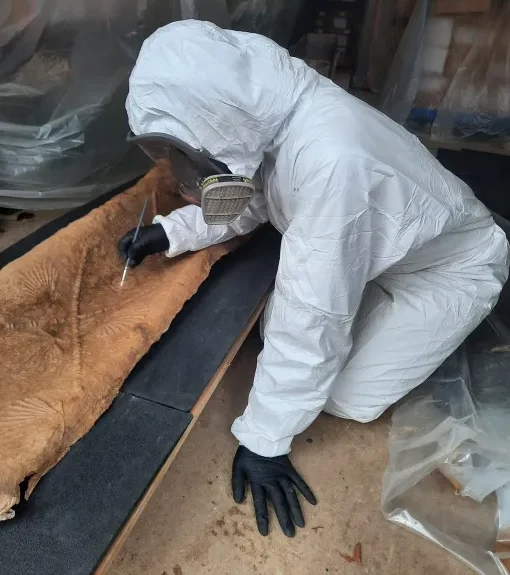
This rectangular Roman lead coffin, complete with a fitted lid, stands out for its decorative design. Both the lid and casket are adorned with scallop shell, rod and circular motifs, features often associated with Roman funerary symbolism. In particular, scallop shells were closely linked with beliefs surrounding the soul’s journey to the afterlife. They symbolised the crossing of the ocean to the “Blessed Isles”, a mythical paradise in Roman thought.
Before conservation began, the CAT team carried out micro-excavation and block lifting. This meticulous process allows archaeologists to preserve fragile contents and contextual information while removing an object from the ground.
A Rare Level of Preservation
What makes this coffin particularly noteworthy is its condition. Many comparable examples have become heavily distorted or fragmented after centuries of compression in the burial environment. In contrast, this piece survived with relatively little damage. Its decorative elements remained defined and legible, offering valuable insight into Roman craftsmanship and aesthetic choices.
Despite this exceptional level of preservation, the coffin still displayed a number of structural and corrosion-related issues resulting from long-term burial.
A Rewarding Conservation Project
For the conservators involved, the project also provided an exciting opportunity. Roman lead coffins are rare finds, and the combination of surviving decoration, structural integrity and archaeological significance made this an especially rewarding object to work on.

Condition
Distortion and Structural Damage
Although the coffin retained much of its original form and decorative detail, it showed clear signs of stress and deterioration caused by burial conditions. Lead is exceptionally dense, but it is also remarkably soft and therefore prone to warping over time.
The lid, for example, had developed a noticeable concave distortion and featured a substantial stress fracture near its centre. Part of the edge had partially detached at this point. While much of the decorative surface survived intact, some edges had become brittle, resulting in localised fragmentation and loss.
The body of the coffin had also warped slightly but largely retained its original form. The most significant damage occurred on one side near the head end, where part of the wall collapsed during burial and later detached. This fragment was especially fragile and displayed extensive active corrosion in the form of powdery white lead carbonate.
Interior Condition
Other areas of concern included minor edge loss, surface abrasion and structural strain. These issues were particularly noticeable at the head plate, which had begun to bend outward under its own weight.
Inside the coffin, corrosion was more advanced than on the exterior, and traces of burial soil remained adhered in several areas. An unusual teardrop-shaped corrosion feature near the centre of the interior added a further point of interest. It may relate to the burial contents or burial environment.
The Challenges of Conserving Lead
The conservation of archaeological lead objects presents particular challenges. Because lead is amphoteric, it reacts with both acids and alkalis. As corrosion develops, bulky corrosion products form beneath the original surface, forcing it outward and sometimes causing it to detach entirely.
Unlike iron or copper artefacts, where conservators can often remove corrosion layers to reveal the original surface beneath, corrosion in lead can permanently displace or destroy that surface if deterioration becomes too advanced. Fortunately, active corrosion was relatively limited in this case, and the coffin’s decorative elements remained exceptionally well preserved.
Treatment
Cleaning and Surface Stabilisation
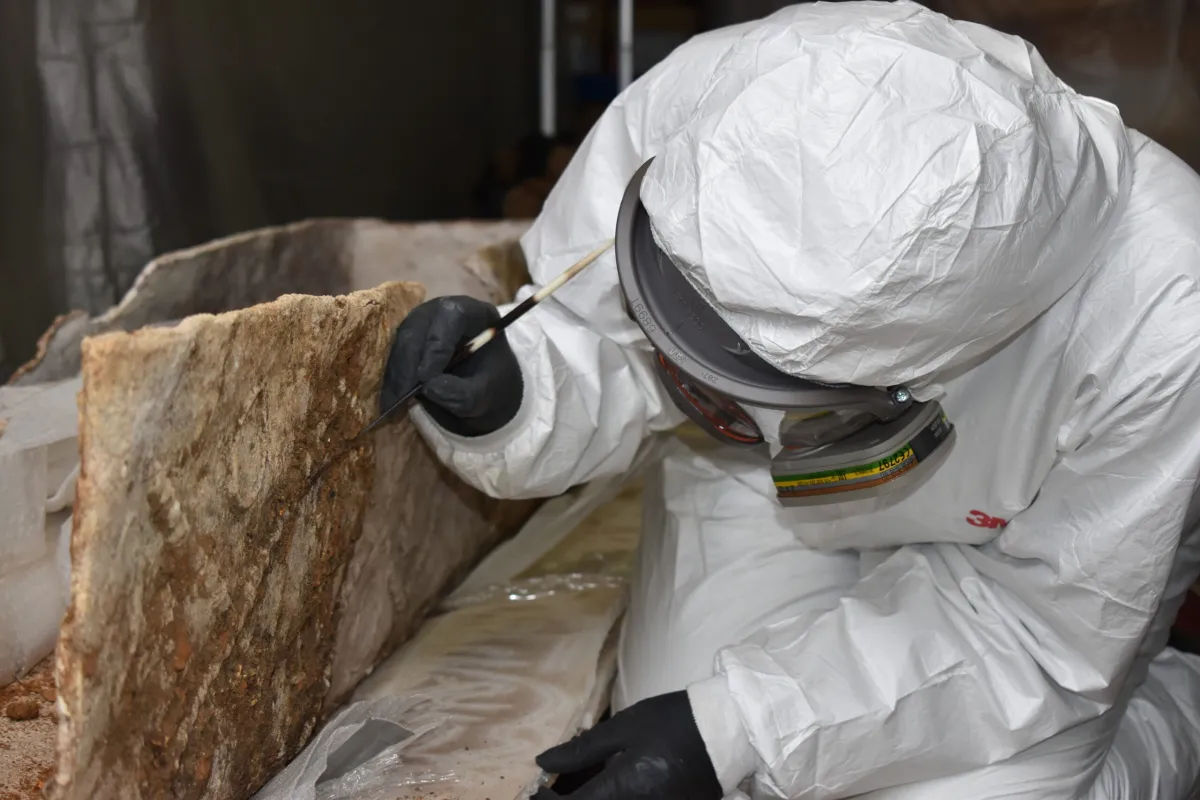
Conservation work focused on stabilising the coffin while improving the visibility of its decorative features. Treatment began with the careful removal of burial soil and active corrosion. Conservators used soft brushes, specialist tools, a museum-grade vacuum and, in some particularly delicate areas, a porcupine quill.
The quill proved especially useful around fragile corrosion layers and decorative details. It allowed conservators to reduce deposits with remarkable precision while minimising the risk of scratching or damaging the surviving lead surface.
Due to the toxicity of lead, conservators wore full PPE throughout treatment, including Tyvek suits, gloves and full-face respirators to prevent inhalation and skin contact. While essential for safe handling, this protective equipment made conservation work physically demanding, particularly during long periods of close, highly detailed treatment that required careful dexterity and concentration.
Consolidation and Repair
To remove finer residues, conservators applied a solvent solution to lift dust and dirt without introducing harmful moisture. They consolidated fragile areas, including cracks, weakened edges and detached fragments, using a conservation-grade acrylic resin to improve structural stability.
Where possible, conservators reassembled detached fragments and secured them in their original positions. Fragments considered too heavy or unstable for safe reattachment were instead supported and stored within the coffin on custom-made mounts. A lighter consolidant layer was then applied across vulnerable areas to provide additional overall stability.
Finishing and Repacking
Finally, conservators carefully blended visually disrupted areas using microcrystalline wax. This helped restore a more unified appearance while remaining sympathetic to the object’s condition and history.
They then repacked the coffin and lid using stable, inert materials, including Plastazote foam supports, to ensure safe handling and storage.
Display and Further Information
The coffin is now on display at the Roman Circus Visitor Centre in Colchester as part of the temporary exhibition, ‘The Lexden Lady: From Burial to Biography’, from 16 May 2026 until May 2027.
Further information about the individual, the coffin and the results of the analysis can be found on the Colchester Archaeological Trust exhibition page.