
By Morgan Creed – Conservator
Assemblage Background
In 2016, East Riding Archaeology (ERA) excavated a Bronze Age and early medieval cemetery comprising 107 graves, 50 of which were investigated. All contained human remains, sometimes with multiple individuals; except for one horse burial. Bronze Age grave goods included ceramic food vessels, worked flints, and a bone pin. Over 1,100 early medieval objects were recovered, mostly glass and amber beads, along with brooches, wrist clasps, dress accessories, iron knives, a few weapons, and an ivory bag ring.
As part of York Archaeology’s post-excavation assessment, the YA Conservation Laboratory conducted a conservation assessment. This included X-raying metallurgical small finds, identifying materials, and assessing their condition. Based on this, recommendations were made for further conservation and long-term storage. Finds specialists were also consulted to identify the function and date of objects and to compare them with parallels from other sites, helping to assess the assemblage’s overall significance.
Condition
X-raying each metal find helps conservators and specialists see beneath thick corrosion layers and assess how much metal remains. It also creates a post-excavation record, which is crucial as objects begin to degrade once exposed to oxygen. After X-radiography, all small finds are examined under a microscope at x20 magnification to confirm the material identifications made in the field, and assess condition and stability.

The Kilham assemblage included two fragmented, wet-packed antler combs. Wet-packing fragile, waterlogged materials like glass, ivory, and antler allows controlled drying in the lab to prevent degradation. The combs had worn, soft surfaces, with details obscured by sand and silt. Also wet-packed were 289 amber beads, many with sand-filled holes and the surface obscured by dirt. Several showed signs of deterioration, including brittleness, flaking, yellow residue and surface crazing. The beads were generally medium-sized and irregular, with common shapes including spheres, cylinders, and cubes. In addition, 651 glass beads were recovered. Though slightly abraded by burial conditions, they were mostly stable and came in a wide range of colours—deep blue, pale green, white, yellow, black, grey, turquoise, light blue, purple-black, dark green, and red. Other bead materials included jet, stone, and fossilised coral.

The assemblage included 103 copper alloy objects, mostly in fair condition. Some showed evidence of bronze disease: light green, powdery corrosion, however this can be managed through dry storage. Most had stable green patinas beneath the corrosion crust, with some revealing silvery surfaces under magnification, possibly indicating plating or differential corrosion. While most brooches were well preserved, several pins were missing, likely due to their original iron composition, which corrodes more readily than copper. One find, with red and blue enamel, was wet-packed to preserve it until it reached the laboratory.
Sixty iron objects were also excavated, most showing signs of active corrosion, typically caused by moisture from the soil. Prompt drying after excavation is essential to prevent further deterioration. Many had thick corrosion crusts obscuring surface details, but X-radiography revealed that some original iron remained within the cores.
Mineral Preserved Organics (MPOs)
When metals corrode in close proximity to organic materials, the corrosion products can mineralise the organics, preserving their shape. These fragments, known as mineral preserved organics (MPOs), can include textiles or small pieces of wood on nails. Many Kilham finds featured MPOs, such as fabric folds around brooch pins, a leather sheath remnant on a knife and, on one brooch, even a fragment of human skin.

Treatment
The first step in conserving the Kilham assemblage was cleaning and drying the wet-packed finds to stabilise them for long-term storage. Depending on material and condition, this involved either controlled air-drying to prevent distortion and cracking, or ‘solvent drying’ for fragile objects like glass. In this method, the find is placed in a gradually increasing acetone/water solution until all water is replaced, then air-dried. As acetone has lower surface tension than water, it causes less stress on delicate materials as it evaporates.

Once the objects were dried and stabilised, ‘investigative conservation’ began: a process involving minimal intervention to aid object identification and help specialists better understand the find’s features. This might include limited cleaning of areas of technological interest or partial reassembly. Full cleaning and reconstruction are typically reserved for museum display.
Specialists Ian Riddler (expert in small finds) and Sue Harrington (an authority on Anglo-Saxon burial textiles) assessed the Kilham assemblage post-excavation and recommended further work to improve understanding. This can present challenges, as different specialists may seek different information from the same object, requiring careful conservation to preserve all the relevant materials.

Kilham offered a rare opportunity for in-person collaboration between textile specialist Sue Harrington and conservator Morgan Creed. While communication usually happens via reports or email, working side by side allowed Morgan to better identify minerally preserved textiles and understand their research potential. Sue, in turn, gained insight into conservation techniques applicable to her future work.
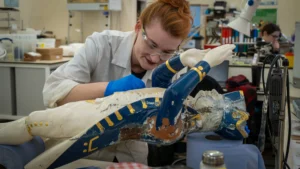
The copper alloy objects, notable for their decoration, were cleaned under a microscope with a scalpel, to reveal features or confirm plating. Cleaning of the mineral preserved textiles was done in consultation with Sue, using wooden tools under magnification to expose the textile weave.
The finds from Kilham have now safely been deposited with East Riding of Yorkshire Council Museum Service, where they will be cared for, for future generations to enjoy.
More information about the excavation at Kilham, East Yorkshire can be found here.