By Morgan Creed
Object Background
A Familiar York Landmark
A clock has been a familiar feature of Coney Street in York since 1668. The current clock face, mounted on a decorative bracket, dates to 1856. Above it stands the ‘Little Admiral’, a figure that has marked the passing of time since 1778.
In 2012, The Cumbria Clock Company restored the clock and cleaned and repainted the Little Admiral. During a routine maintenance inspection in 2021, inspectors identified splits and surface damage that required further conservation work. They removed the figure and brought it to York Archaeology Conservation for assessment and treatment. At first, conservators suspected that deathwatch beetle activity had damaged the wooden figure. As a precaution, they froze the Little Admiral to eliminate any possible infestation. However, closer examination revealed that long-term weather exposure had caused most of the deterioration.
Condition
Understanding the Construction
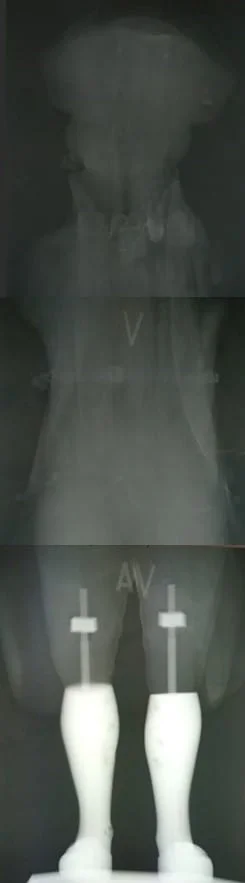
The Little Admiral consists of several components, including a wooden body and cast-iron structural elements. To understand how the figure had been made and to identify any hidden damage, conservators used X-radiography to examine its internal structure.
The X-rays revealed that the Little Admiral’s legs are made from cast iron, with metal rods extending upwards to support the wooden body. The makers likely included the cast-iron legs to add weight and stability, helping to prevent the figure from toppling in strong winds.
Cracks in the wood initially raised concerns that corrosion in hidden metalwork might be forcing the wood apart. However, the X-rays ruled this out. The ironwork remains in very good condition and shows little or no corrosion. The images also revealed evidence of an earlier repair, where someone had added a screw to strengthen the join between the body and the right arm.
Structural Deterioration
The wooden body is carved from walnut and constructed from four laminated planks. Over time, repeated expansion and contraction caused by changing weather conditions forced these planks apart. The damage became so severe that parts of the figure, including the arms and back section, detached. During examination, conservators temporarily secured the planks with cable ties.
Once they dismantled the figure, conservators identified extensive wood rot as the primary cause of damage rather than insect attack. Years of exposure to rain and moisture allowed fungi to break down the wood from within. The design of the tricorn hat worsened the problem. Its shape encouraged rainwater to collect rather than drain away. As the protective paint layers failed, water penetrated deeper into the wood and accelerated the decay.

Surface Condition
The painted surface was cracked and lifting, particularly along joins where movement in the wood had caused the layers to separate. Years of outdoor display had also allowed dirt, pollution, algae and other biological growth to accumulate on the surface. Examination of damaged areas revealed that the Admiral’s coat was originally a lighter shade of blue and featured gilded details rather than painted gold.
Conservators also noted that the figure carried far fewer paint layers than expected for an outdoor object of this age. This suggested that earlier paint schemes had been stripped away before someone repainted the figure using modern materials. Paint analysis confirmed this theory. Conservators tested samples to determine whether lead was present and detected only trace amounts in a small area likely to retain remnants of earlier finishes. This confirmed that the visible paint layers are modern and lead-free.
Conservation Treatment
Repairing the Little Admiral
Conservation work focused on stabilising the structure, repairing weathering and rot damage, and restoring the figure’s appearance.
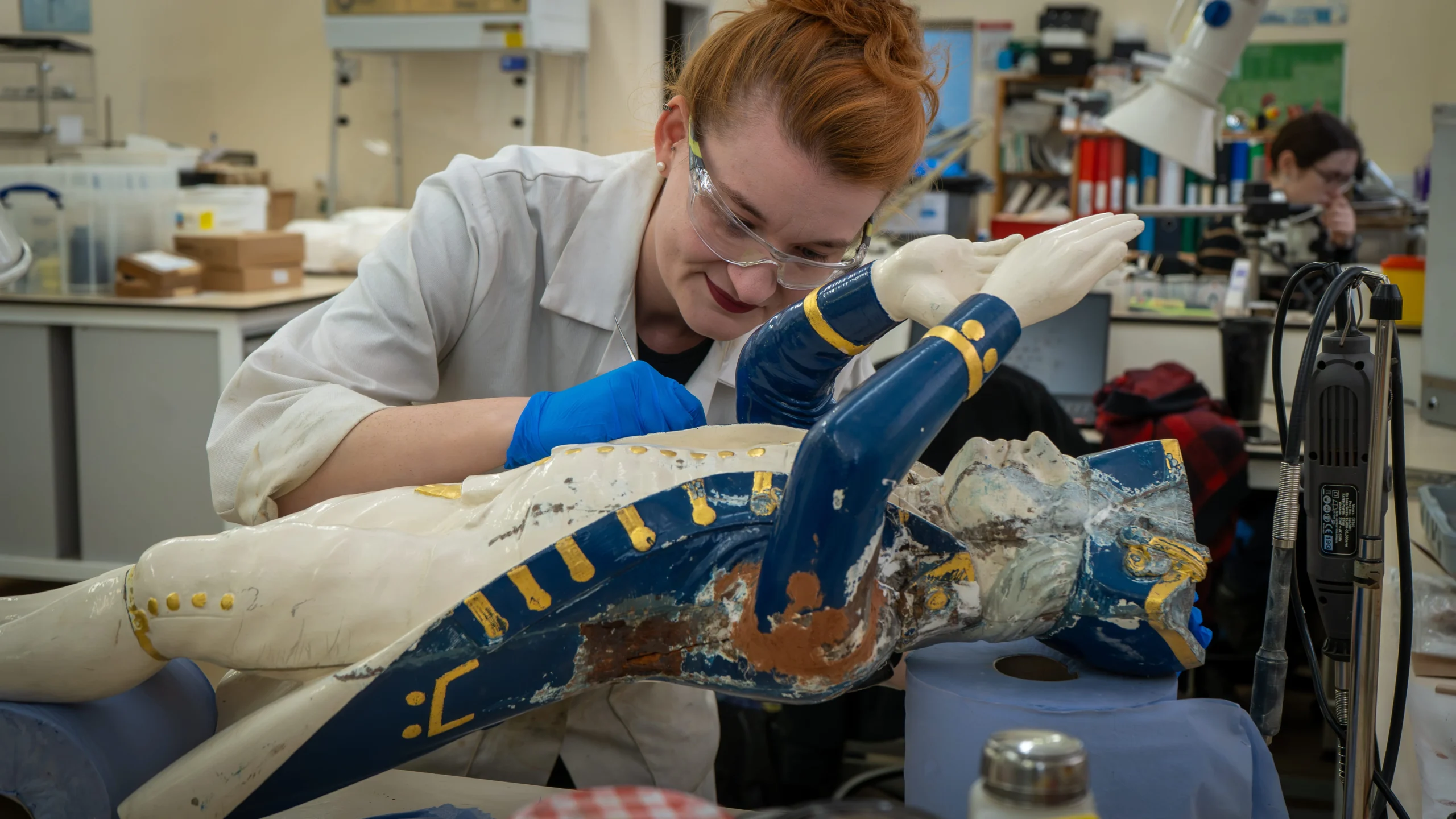
Conservators first cleaned the surface to remove accumulated dirt, dust and biological growth. They carefully removed areas of algae and lichen and gently cleaned the painted surfaces to reveal original colours and details.
The team dismantled earlier repairs that had failed over time, including old screws, wooden dowels and adhesive residues. They then strengthened the severely weakened wood with a consolidating treatment that penetrated deep into the timber and improved its stability. Conservators filled areas where decay had destroyed wood to support the remaining structure.
After strengthening the timber, they carefully reassembled the separate sections and reattached them. They then filled and reshaped missing and damaged areas to match the original form. Following these repairs, conservators smoothed and refined the surfaces. In some areas, they reduced later paint layers to reveal details that had become obscured over time.
The team also treated the cast-iron base and support structure. They removed corrosion products and excess paint residues before preparing the metal surfaces for repainting. Although the ironwork remained structurally sound, these treatments improved its appearance and provided long-term protection.

Repainting and Re-Gilding
Conservators then primed and repainted both the wooden and metal elements. They chose traditional linseed oil paints because they are durable, breathable and flexible, helping to prevent future rot.
Previous analysis had shown that the Admiral originally looked quite different from the modern colour scheme. As a result, conservators restored the coat to a lighter shade of blue.
Finally, they re-gilded the decorative gold details, including elements of the uniform and sight staff, with 24-carat gold leaf. This work restored the figure’s distinctive appearance and reflected evidence uncovered during conservation that these features had originally been gilded rather than painted.
Display of the Original Little Admiral
Although conservators have stabilised the Little Admiral, they no longer consider it robust enough to return to its original position above the clock on Coney Street. Instead, visitors can now see the Little Admiral inside St Martin-le-Grand Church, where it sits in a purpose-built museum case. This environment provides greater protection from deterioration and allows visitors to appreciate details that are impossible to see from street level.
Creating a Replica for the Clock
To maintain the historic appearance of the clock on Coney Street, a replica is currently in production. Following consultation with Keith Scobie-Youngs of The Cumbria Clock Company, the project team decided to create the new Little Admiral in bronze. This material will provide far greater durability than wood and prevent the same type of deterioration.
Following conservation, York Archaeology Conservation digitally recorded the original figure using high-resolution 3D scanning. Heritage 360, a specialist heritage research and digital documentation team based at the University of York, carried out the scanning in the YA Conservation laboratory. The process captured the Little Admiral’s shape, details and surface features with great accuracy and created a permanent digital record of the object.
The 3D scan of the Little Admiral can be viewed below.
Bronzecast will create the replica using the digital 3D scan of the original figure. The company will first use the scan data to produce a highly accurate 3D print. It will then create a silicone mould from that print before casting a new Little Admiral in bronze. This process will produce a durable replica capable of withstanding outdoor display.
Once Bronzecast has completed the casting, York Archaeology Conservation will paint and gild the bronze replica to match the original appearance revealed during conservation.
The team will then reinstall the completed figure above the clock on Coney Street. This will ensure that the Little Admiral continues to mark the passage of time and remains a familiar feature of York’s historic city for generations to come.
Acknowledgements
The Feoffees of St Martins and St Helens funded the restoration and display of the Little Admiral, primarily through support from the Potter Kirby Trust (registered charity no. 257249).
The trust was established in memory of George Arthur Potter-Kirby following his death in 1967. Its primary objective is to provide for the repair and maintenance of St Martins and St Helens churches, “and the organs, furniture and ornaments thereof”.