
Introduction
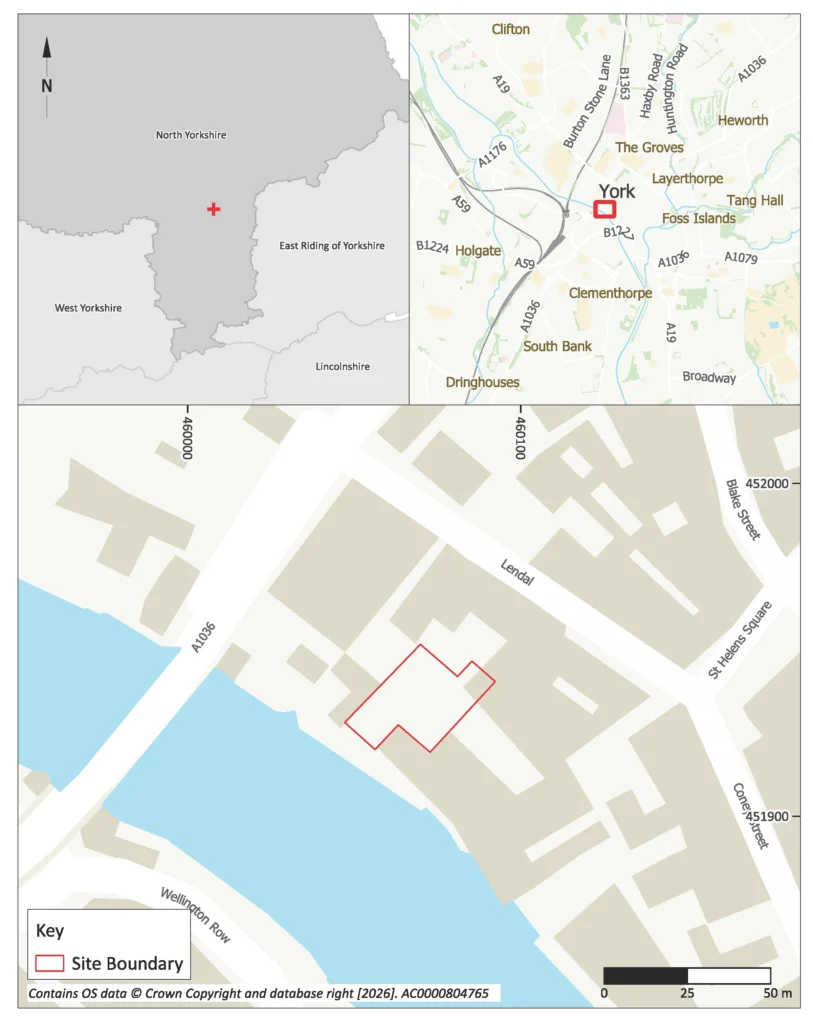
In 2016, the City of York Council began a project to renovate and redevelop the historic Guildhall. As part of these improvements, a new extension was built on the north side of the complex, designed by Burrell Foley Fischer and constructed by VINCI Construction.

We detailed the Roman remains in an earlier blog post, and now we bring you the medieval and post-medieval discoveries.
It is worth noting that, despite the site’s central location, it does not appear to have been heavily used between the end of the Roman period and the Norman Conquest.
The Medieval Period
The return of the site to use in the Anglo-Norman period involved dismantling the 3rd-century wall. This was probably done to recover useful building stone and to clear the area for new purposes.
Few artefacts from this period were found on the site. However, one notable discovery was a silver penny from the reign of William I.

The 12th and 13th centuries were a period of population growth for York, bringing significant social and economic changes. It was during this time that buildings began to reappear on the site.
The Augustinian Friary
Historical documents show that by 1272 an Augustinian friary had been established on the site.
Virtually all trace of the friary was lost following the Dissolution of the Monasteries in the 1530s, and not much is known about its appearance or layout. However, recent excavation has revealed some of its remains.
Some buildings, including one with a large hearth dating to around the mid-13th century, belong to an early phase of the friary.

Important changes to the extent of the friary took place throughout its lifespan, and historical accounts record that buildings, including a new dormitory, were built in the 15th century.
Walls from a substantial building were found in the north-west part of the site, with a possible cloister graveyard to the south-east.


The Post-Medieval and Modern Periods
After the Dissolution of the Monasteries, the friary passed into private ownership, and the buildings within the precinct were dismantled down to foundation level.
In 1714, Henry Baines built three townhouses on Lendal. Their gardens originally ran down to the riverbank, and these houses still stand on the street today.
The North Annexe was built around 1902, and the ‘Hutments’ by 1945.
The new extension to York’s Guildhall is the latest chapter in the long and varied history of this site.