By Gareth Davies
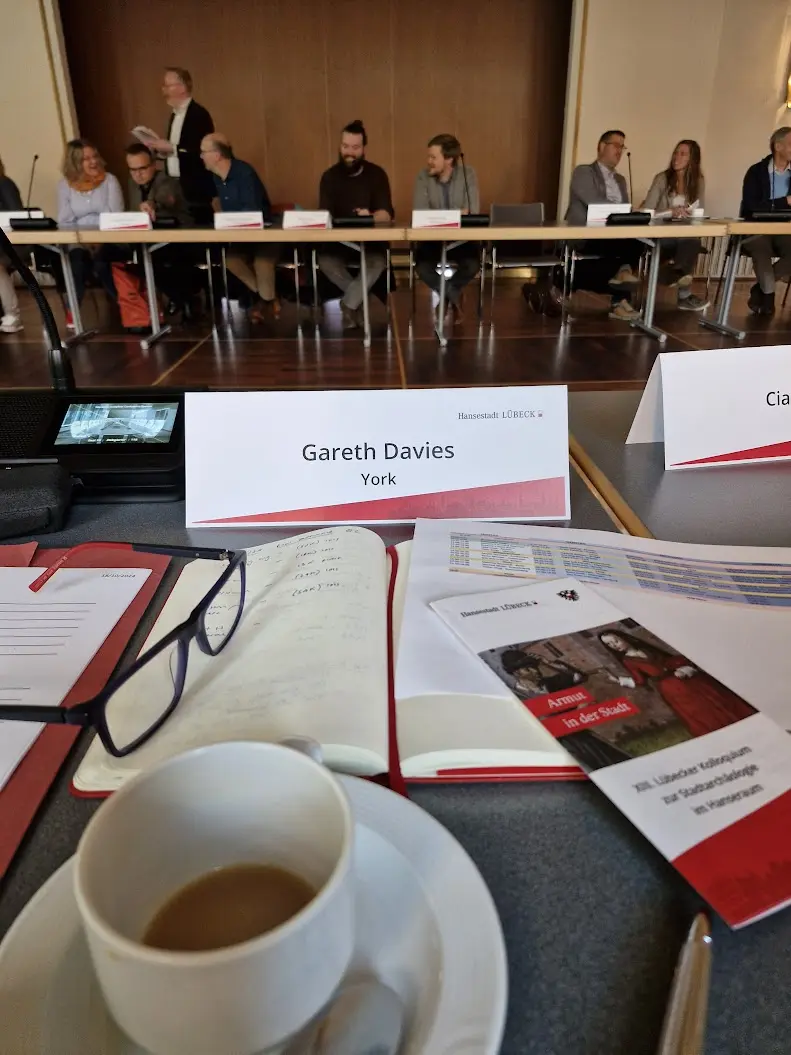
Last week I attended the 2024 Colloquium on Urban Archaeology, with which this year focussed on’ Social and Urban periphery – “poverty in the city“’. The conference offered delegates from 42 different cities in the Hansa region an opportunity to better understand the lives of marginalized groups within medieval cities. The complexities of defining poverty and social periphery were first confronted. This was followed by an exploration of material culture and spatial distribution of marginalized communities, and considerations of the potential for characterising these groups. There were several excellent papers highlighting a variety of approaches, from an extensive GIS-led study by Kirsten Haase (Odense, Denmark) through to micro-biological approaches to the study of cess pits and other waste streams by Ann Degraeve (Brussels). There were also several case studies that highlighted the agency of individuals and communities on a very human level, such as the cemeteries of poor fisherman in Bremen (Germany) and marginal coastal communities at Hoorn (Netherlands).
My paper looked at both the archaeological and historical evidence from York. The analysis of material culture, including vernacular buildings, portable artefacts, and environmental remains, can offer valuable insights into the lives of the urban poor. However, there are challenges of interpretation; material culture is seldom exclusive to a single social group, and baseline indicators of poverty may change over time (for example a wealthy 13 th century York compared to a post black death York of the 15 th century). A successful study of the urban poor must therefore confront this problem of relativism and look at social differentiation in general. Here I emphasized the importance of interdisciplinary approaches that combine archaeological, historical, and environmental data. However, this also has challenges with, for example, documentary evidence focussing on the good deeds of wealthy individuals at the expense of marginalized groups. I concluded by looking in some detail at York’s excavated cemeteries, such as St. Helen-on-the-Walls, St. Andrew’s Fishergate and Jewbury, which provide further opportunities to examine social differentiation within urban populations, especially if combined with future scientific analysis. The paper seemed to be well received, and I had some good questions!
In the concluding discussion, our conference convenor, Dirk Reiger of the Lubeck Department Archaeology and Monument Preservation, highlighted some of the common themes that had emerged, including ‘barometer objects’, understanding ‘what is normal’, taking an interdisciplinary approach and looking at urban topography at an extensive scale. The ensuing discussion highlighted the problems of using a historical framework, where
poverty is specific to the mechanics of specific economic situations, and the potential of looking at contemporary medieval definitions of poverty as a theoretical start-point. Our keynote speaker, Brian Ayers noted in conclusion that archaeology can make a difference in the study of the poor, but that we need to use our own interpretative frameworks and develop perspectives that are not trapped by historical narratives. In this sense the colloquium had certainly succeeded in changing the nature of the debate.
Overall, the 2024 Colloquium on Urban Archaeology was a fantastic event that has advanced our understanding of urban poverty in the Middle Ages. It has also reinforced the importance of this network and the amazing potential of addressing research questions in a comparative way and at a European scale.