
By Morgan Creed & Sophie Courtiaud
Object Background
Archaeological objects from Egypt can sometimes begin to deteriorate many years after excavation. One common cause is the presence of salts absorbed during burial that can affect Egyptian Ceramics.
In copper-alloy objects, salt contamination can appear as vivid blue or green corrosion. In ceramics, salts often form white crystalline deposits on the surface. As these deposits grow, they can cause the ceramic to crack and the surface to flake away.
Salt contamination is particularly common in Egyptian artefacts because many burial environments, especially in the Nile Delta region, contain high levels of soluble salts. These salts absorb moisture from the air and move through porous ceramic objects. When conditions become drier, the moisture evaporates and the salts crystallise. As the crystals grow, they place pressure on the ceramic fabric, causing it to weaken and crack.
Curators at Touchstones Rochdale identified signs of salt damage on two Egyptian ceramics in the collection: an amphora and a soul house.
Condition

Soul House
A soul house is a small clay model of a house or shrine that people placed in tombs during Egypt’s Middle Kingdom period (c. 2055–1650 BCE). These models were believed to provide a resting place for the deceased person’s soul and may also have served as symbolic offering trays for food left by the living.
The soul house is made from fired clay and varies in colour from red-brown to light orange. Examination of broken edges shows that the maker fired the object at a relatively low temperature, leaving the ceramic soft and fragile. Parts of the upper walls and an area beside the doorway are missing, although this damage appears to date from antiquity. A large crack runs from the back wall through the doorway. Evidence suggests that this crack formed during manufacture.
White salt deposits covered much of the surface. As salts moved through the ceramic and crystallised, they caused the surface to flake away and exposed the underlying clay. Very little of the original surface survives. Small fragments continued to detach, as shown by debris recovered from the object’s storage packaging.

Amphora
An amphora is a ceramic vessel used throughout the ancient world to transport and store liquids such as wine or oil. This example is made from fired clay and varies in colour from red to light orange.
The amphora remained in fair condition , although like many Egyptian ceramics, it remained vulnerable to further deterioration from salt activity. White salt deposits covered parts of the surface and caused areas of lifting and flaking. The most severely affected areas include the base, shoulder and parts of the neck, where the ceramic surface had become particularly fragile. Fortunately, the inscription on the shoulder of the vessel remained unaffected.

Treatment
Before the Egyptian Ceramics arrived at the laboratory, conservators proposed immersion desalination as a possible treatment. This process places an object in a series of water baths to gradually remove harmful salts. Conservators monitor the salt content of the water throughout treatment. Once the salt concentration falls to a safe level, they transfer the object to a final bath of purified water and then allow it to dry naturally.
Conservators successfully removed salts from the amphora using immersion desalination. However, closer examination showed that immersion was not suitable for the soul house.
The maker had fired the object at a relatively low temperature, producing a soft and fragile ceramic body. Prolonged exposure to water could weaken the clay further or even cause it to begin dissolving. Conservators therefore ruled out immersion desalination and evaluated two alternative approaches.
Option 1: Surface Stabilisation and Controlled Storage
This approach focuses on stabilising the soul house and preventing further deterioration rather than removing salts from deep within the ceramic.
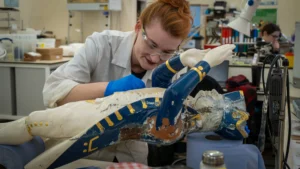
Conservators would first remove visible salt deposits using a soft brush. They would then collect detached salts with a specialist museum vacuum operating at very low suction to avoid damaging the object. After removing the surface salts, conservators would apply a conservation-grade adhesive to strengthen the fragile ceramic and secure any loose surface layers.
This treatment would not remove salts from within the soul house. However, carefully controlled storage conditions and stable humidity could greatly reduce future salt activity.

Option 2: Surface Stabilisation and Salt Removal by Poulticing
This approach aims to reduce the amount of salt within the object while avoiding the risks associated with immersion in water.
As with Option 1, conservators would first remove visible salts using a soft brush and specialist museum vacuum. They would then strengthen the fragile ceramic with a conservation-grade adhesive to ensure it could withstand treatment.
Once the object had been stabilised, conservators would apply a damp clay-based poultice to the surface. As the poultice dried, it would draw dissolved salts from the ceramic and into the clay. After drying, conservators would carefully remove the poultice and measure the amount of salt extracted during each treatment cycle. They would repeat the process as necessary until salt levels fell to an acceptable level.
Option 2 offers the advantage of actively removing harmful salts from the ceramic and reducing the risk of future deterioration. However, the treatment is more invasive and carries a greater risk of causing damage to the object.
Selected Treatment
Conservators ultimately selected Option 1 as the preferred treatment for the soul house because it offered a less aggressive approach while still reducing the risk of future deterioration.
Further information
Learn more about the collections at Touchstones Rochdale here.