by Dani Shacklock, Project Supervisor (York Fieldwork)
During 2018, a team from York Archaeology conducted an excavation at Wetherby Road Roundabout, York on behalf of the City of York Council. The work finished on Halloween, and the spirits of the past could indeed be felt as the team gathered their tools and their observations and set off back to York at the end of the final day.
A Prehistoric Agricultural Landscape
The team uncovered clear evidence of a Late Iron Age / Romano-British agricultural settlement during the excavation. This adds to a rapidly growing database of prehistoric sites from across the York area. Although prehistoric remains are rare within the city itself, the surrounding area has now been proven to be a widely settled and exploited landscape by the beginning of the Roman period.
The area around York is an agriculturally attractive landscape. Sandy and loamy soils provide excellent drainage, as well as a natural vantage point across the lower-lying Vale of York. Its appeal to prehistoric settlers is clear.

One of Yorkshire’s Largest Ring Ditches
The excavation revealed a ring ditch with a staggering diameter of 15.5m (that’s bigger than the Hollywood sign!), making it one of the largest yet found in Yorkshire.
Decorated pottery, a quern-stone fragment, and molten slag were found within the fill of this feature.

Evidence of Domestic Activity
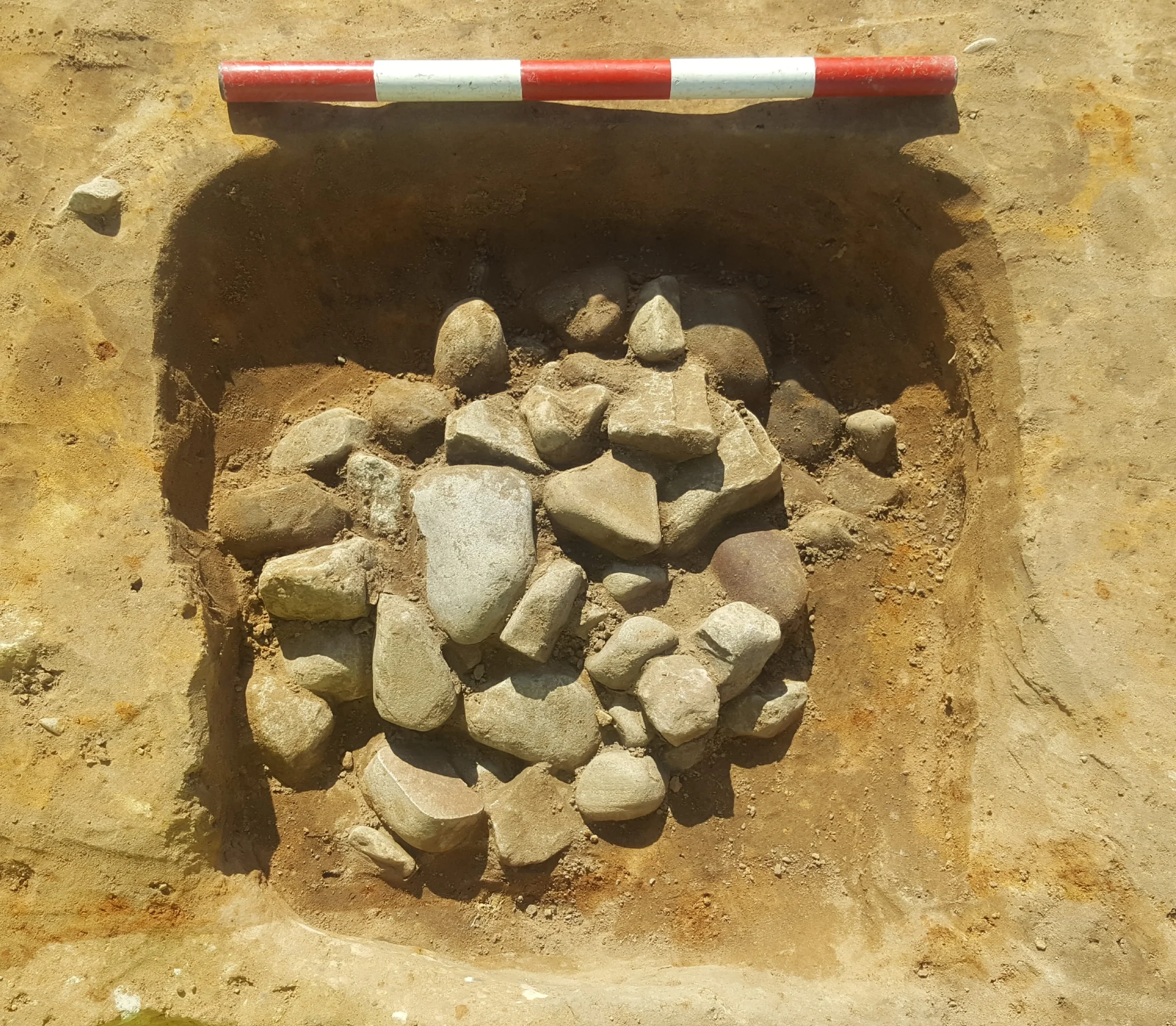
Inside the ring ditch, archaeologists found charcoal-rich pits and a possible hearth. The hearth contained charcoal and fire-cracked stones, suggesting that it was likely a ‘pot-boiler’ hearth. In this method, stones were heated in a nearby fire and then dropped into pots to boil the water inside, rather than using an open wood fire.

The site also produced evidence for large watering holes for livestock.

Unusual Imported Finds
Perhaps the most unusual finds from this site were multiple fragments of pumice, a type of rock made predominantly of volcanic glass. As pumice is not found locally, it would have been imported.
Pumice is most commonly found in the countries that ring the Mediterranean, particularly Italy, Turkey, and Greece. It has many uses and has been used throughout history for a variety of purposes, including skin exfoliation, as an additive for concrete, and even in the earliest recipes for toothpaste in Ancient Egypt, where pumice was mixed with ox hoof powder, burnt eggshell, and ashes (yuck!).
In the medieval and Renaissance periods, scribes also used pumice to smooth parchment, while artists used it in sculptures and paintings.
The Wider Landscape
Aerial photography of the fields around the site shows evidence of associated pits and field boundaries. These lay outside the edges of the site and were not excavated, but they add further evidence for a widely settled agricultural landscape.