
By Steve Allen
Background
Hungate is a low lying area of York within the medieval city walls but south east of the Roman Fortress, on the banks of the second of York’s rivers, the Foss. The site came up for a major redevelopment project and in October 2008 York Archaeology excavated a sondage in the corner of the Hungate site to give a preview of the nature of the archaeology to be recorded.


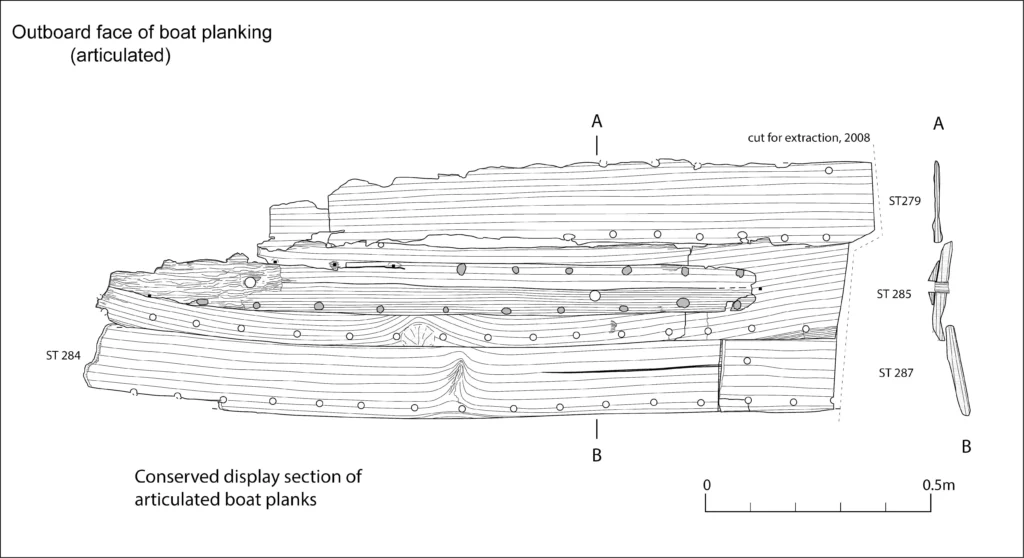
This ‘Test pit’ turned out to have been placed directly over the end of a building of Viking age date. The timbers initially exposed were lifted and recorded, and the rest of the building was excavated in step with the surrounding area in November 2009. While the overall appearance of the building matches those of later 10th century date at Coppergate, the detail of the planking was very different. The builders had reused articulated slabs of a ship hull. While still a clinker-built vessel, the planks were fastened with wooden pegs rather than iron rivets (so not Scandinavian) and tree ring dating by Ian Tyers showed that the planks came not from Yorkshire, but from south-east England. They were felled after AD 953 and the building of which they were part was constructed in AD965
Condition
The timbers were preserved by burial in a waterlogged anoxic environment. Apart from some slight surface abrasion they were in good condition. The wood species of the boards is Oak (Quercus spp.) and while some of the pegs are also Oak, there are a significant number of Willow pegs (Salix spp.) as well.




Treatment
After their stratigraphic and spatial location was recorded, the timbers were lifted and taken off-site for cleaning, detailed timber recording and drawing by the woodworking specialist.
However if waterlogged wood is left to dry under uncontrolled conditions, the weakened cell walls will quickly collapse, causing the wood to split, shrink and distort. This damage is not generally reversible.
To replace the lost wood substance the timbers were immersed in a solution of water soluble wax for around a year, then freeze dried to remove the remaining free water under controlled conditions. When this was complete, the timbers were given a final clean and wrapped up for archival storage.
One section has since been mounted on a frame and placed on public display in DIG. This section is intended to be loaned to the Yorkshire Museum in the summer of 2025.